September 29, 2026
Harley-Davidson Evolution and the 1996 Heritage Softail Special: History, Ferry Clot and Costa Tropical Rides
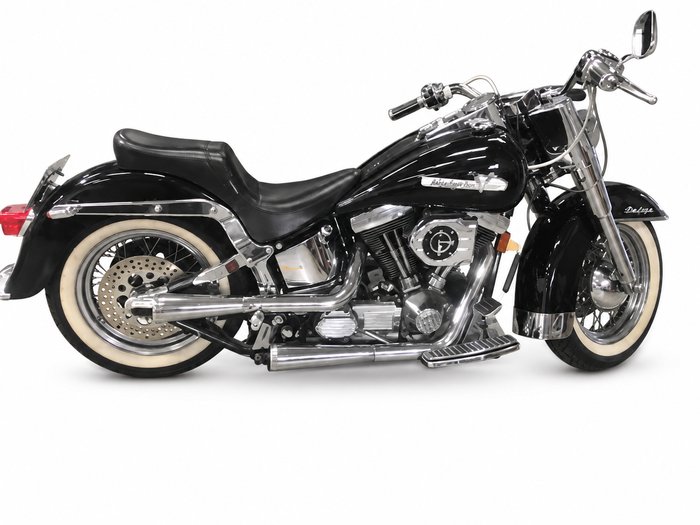
Some motorcycles you rent; others you experience. The 1996 Harley-Davidson Heritage Softail Special joining the Tropical Riders fleet belongs firmly in the second group: a Big Twin with the legendary 1340 cc Evolution engine, the Softail chassis with its hidden rear suspension, and styling that looks straight back to the 1950s. On top of that, it is a bike customised by Ferry Clot, the Spanish builder who twice won the Modified Harley-Davidson class of the custom bike building world championship held in Sturgis, USA. In this article we look at the story behind each of those ingredients, and at how to enjoy the bike on the roads of the Costa Tropical.
Harley-Davidson on the brink: from AMF to "The Eagle Soars Alone"
To understand why the Evolution engine holds such a special place in Harley-Davidson history, you have to go back to the late 1970s. In 1969 the Milwaukee company had been taken over by the conglomerate American Machine and Foundry (AMF). Production grew, but the bikes' reputation suffered, just as Japanese manufacturers were flooding the market with smooth, reliable, oil-tight engines.
The Shovelhead and the "leaky Harley" reputation
The Big Twin engine of the day was the Shovelhead (1966-1984). It had character, but also a reputation that was hard to shake: a tendency to leak and burn oil, high running temperatures and patchy reliability. According to Hagerty, the problems were so well known that some magazines hesitated to test the bikes at all. The joke about a Harley "marking its territory" with a puddle of oil dates from those years.
1981: thirteen executives buy the company back
On 16 June 1981 a group of thirteen executives, led by Vaughn Beals and including styling chief Willie G. Davidson (grandson of co-founder William A. Davidson), bought Harley-Davidson back from AMF for around 80 million dollars in a heavily leveraged deal. The company itself called that moment "The Eagle Soars Alone". Shortly afterwards, in April 1983, the Reagan administration approved a temporary tariff on Japanese motorcycles over 700 cc following Harley's petition to the US International Trade Commission. But the real lifeline had to be an engineering one.
The Evolution engine: the V-twin that saved Harley-Davidson
Work on a new engine had started in the mid-1970s. Harley was running two projects in parallel: the Evolution, developed in-house, and the ambitious Nova, contracted out to Porsche. When, in 1981, there was only money for one, the Evolution was chosen. Under engineering chief Jeff Bleustein, reliability took priority over a rushed launch, and the engine finally arrived in the 1984 models. Engineers nicknamed it the "Blockhead", continuing the Flathead, Knucklehead, Panhead and Shovelhead tradition, but the name that stuck was Evolution, or simply Evo.
What changed compared with the Shovelhead
The Evo kept Harley's classic architecture (a 45-degree V-twin with pushrod-operated overhead valves and bottom-end cases very similar to its predecessor), but the top end was all new:
- Aluminium cylinders and heads, lighter and far better at shedding heat than cast iron.
- Smaller valves at a narrower angle and flat-top pistons instead of domed ones.
- Stronger connecting rods and a redesigned lubrication system that put an end to chronic oil leaks.
- More power and torque than the Shovelhead it replaced (Hagerty quotes roughly 10 per cent more power and 15 per cent more torque).
Harley was so confident in the new engine that, according to Hagerty, it came with a 12-month, unlimited-mileage warranty, unthinkable only a few years earlier. English Wikipedia sums up a view shared by many analysts: the Evolution was the engine that saved the reorganised Harley-Davidson from bankruptcy.
Evo 1340 at a glance
| Item | Value |
|---|---|
| Type | 45° V-twin, four-stroke, air-cooled, 2 valves per cylinder (OHV) |
| Displacement | 1340 cc, marketed as 80 cubic inches (≈1338 cc actual) |
| Bore × stroke | 88.8 × 108 mm |
| Compression | 8.5:1 |
| Fuel system (1990s) | Keihin constant-velocity (CV) carburettor |
| Years in Big Twins | 1984-1999 (Softails up to 1999; one special model in 2000) |
1984-1999: the Evo years
For a decade and a half the Evo powered Harley's entire big-bike range: Softail, FXR, Dyna and Touring. From 1986 a smaller version also went into the Sportster (first 1100 cc, then 883 and 1200 cc), which kept it until 2022, when emissions rules ended the classic line; in Europe, Euro 5 had already retired those Sportsters earlier. In the Big Twins, the Twin Cam 88 took over in 1999 on Dyna and Touring models, and on the Softails for model year 2000 in its counterbalanced 88B form. In other words, a 1996 Softail belongs to the final years of the Evo era.
Why connoisseurs still seek out an Evo
Ask at any bike meeting and you will find the Evo has a loyal following. The reasons are always the same:
- Mechanical simplicity: a carburettor, basic electronic ignition and a layout every Harley mechanic knows inside out.
- Proven reliability: this is the engine that restored the brand's reputation.
- Sound and feel: the pulse of a 45-degree V-twin with no balance shafts, and that famously uneven idle.
- A huge base for customising: the aftermarket for the Evo is enormous, which is why so many builders have used it as their canvas.
The Softail: suspension you cannot see
The other big news of 1984 was the Softail chassis. It came from an independent engineer from Missouri, Bill Davis, who in the mid-1970s designed a triangulated swingarm that mimicked the look of a rigid frame (a hardtail) while hiding the suspension. Davis patented the idea and showed it to Willie G. Davidson in 1976; Harley was not interested at the time, but after the buyback, according to Wikipedia, the company bought his patents in January 1982. Styled by Willie G., the 1984 FXST Softail was born, with its shocks mounted horizontally beneath the transmission, out of sight. The result combined the clean lines of 1940s and 1950s bikes with the comfort of modern suspension. It was an instant success, and the Softail became one of Harley's best-selling families.
The Heritage line: the 1950s reinterpreted
1986: the Heritage Softail arrives
In 1986 Harley applied the Softail formula to an openly retro machine: the FLST Heritage Softail. A chunky Hydra-Glide-style fork, deep valanced fenders, 16-inch wheels and a look that recalled the post-war FL models. The 1949 Hydra-Glide had been the first Harley with a hydraulic telescopic fork, and the Heritage brought that image back. In 1988 came the FLSTC Heritage Softail Classic, with windshield, studded leather saddlebags and passenger backrest: the format that turned the Heritage into a classic the company has kept, in various forms, ever since.
FLSTN: from the "Cow Glide" to the Heritage Softail Special
In 1993, the company's 90th anniversary year, Harley launched a limited edition, the FLSTN Heritage Softail Nostalgia, of which 2,700 were built (2,000 for the USA and 700 for the rest of the world, according to MCNews and MotoGallery). Black-and-white two-tone paint, whitewall tyres, a headlamp flanked by spotlights and, above all, cowhide inserts on the seat and saddlebags. Fans immediately nicknamed it the "Cow Glide" or "Moo Glide". It sold out so quickly that Harley kept the model, no longer numbered, as the Heritage Softail Special, still coded FLSTN, from 1994 to 1996. Cycle World's March 1994 test describes how the first year's Holstein hide gave way to more discreet black Angus cowhide. For 1997 its place in the range went to the Heritage Springer (FLSTS).
Put simply, the 1996 FLSTN is the final year of a very particular Heritage, built in short runs and powered by the Evolution engine, and one that collectors look for today, especially when it retains its original features.
The 1996 Heritage Softail Special in figures
Figures vary slightly between sources (and may have changed on a customised bike), but these are the stock specifications given by spec sheets and period road tests:
| Feature | Heritage Softail Special FLSTN (stock, 1996) |
|---|---|
| Engine | Evolution 45° V-twin, 1340 cc (80 ci), air-cooled |
| Bore × stroke | 88.8 × 108 mm |
| Carburettor | 40 mm Keihin CV |
| Power | Around 50-57 hp depending on the source |
| Torque | About 97 Nm at roughly 2,350-3,000 rpm |
| Gearbox | 5-speed |
| Final drive | Belt |
| Suspension | 41 mm Hydra-Glide-style telescopic fork; hidden rear shocks (Softail) |
| Wheels | Spoked, 16 inch, whitewall tyres as standard |
| Weight | Close to 300 kg (Cycle World weighed 655 lb in 1994) |
| Seat height | About 68 cm |
This is not a bike for going fast; it is a bike for going well. Torque arrives low down, the engine pulls from idle, and the feet-forward riding position on floorboards invites you to cruise and soak up the scenery and the sound.
Ferry Clot: the builder behind this Harley
Its owner describes him as "the guru of Harley-Davidson transformations". The phrase is his, but the track record we have been able to document in the specialist press backs it up: two class titles at the Sturgis custom world championship, bikes shown at contemporary art fairs and commissions from well-known musicians. Motocat magazine even headlined a feature on him as "the true Gaudí of Harley-Davidson".
From bicycles and comics to Harleys
Ferry Clot is a Catalan builder; according to Motocat he was born in Barcelona in 1970. Before motorbikes came bicycles, which he was already modifying as a young man, along with comics, painting and a long career working with metal: the same magazine mentions some 25 years in metalwork before he turned full-time to transforming motorcycles. The passion came from home, through a brother who loved bikes.
Motocat sums up his philosophy in one line: if it has two wheels, it's a motorcycle, and he'll love to modify it. And when asked to define himself, he avoids grand words: "I'm just a craftsman".
Hot Dreams: the workshop
Clot founded Hot Dreams, a workshop dedicated to transforming and building exclusive motorcycles, mostly on a Harley-Davidson base. His career has taken him through Lloret de Mar (Hot Dreams Lloret) and Barcelona, where Motocat describes a garage-workshop in Poblenou with a showroom and a rock-style lounge. It also took him to Marbella, where his workshop was already listed in 2009 according to Motociclismo and from where he entered bikes in the world championship in later years. Motocat also mentions a period with a base in Miami.
Work at Hot Dreams is handmade from start to finish. Motocat lists the techniques that define it:
- Hand-bent tube frames, built from scratch.
- Diamond-cut engraved engines and gold-plated parts: wheels, handlebars or air filters.
- Snakeskin or crocodile upholstery, and inlays as unexpected as casino chips.
- Made-to-measure exhausts, including work on the engine's sound.
- Bikes tailored to the rider: Clot measures the owner and adapts handlebar height, seat position and ergonomics to their body.
According to the same magazine, his commissions range from around €3,000 to more than €100,000, and his clients have included musicians such as Loquillo, Johnny Hallyday and members of Bunbury's band.
2007: Guindilla and the first Sturgis title
The AMD World Championship of Custom Bike Building, organised by the American magazine American Motorcycle Dealer, is the benchmark competition for custom bike builders. In those years its final was held during the Sturgis rally in South Dakota, the biggest motorcycle gathering in the world.
In 2007 Clot decided to take one of his bikes, Guindilla, over there, almost just to see what would happen. He came home with first place in the Modified Harley-Davidson class: a Spanish builder winning at the heart of American custom.
2009: Panafina, the second title
Two years later he did it again. On 4 August 2009, in Sturgis, Panafina won the Modified Harley-Davidson class once more. Clot said he was very proud to have planted a Spanish flag at the heart of the custom world. Motociclismo and Plusmoto described the bike in detail:
- Base: a 1956 Harley-Davidson FL 1200, a Panhead Hydra-Glide, completely stripped down.
- Girder fork with curved legs, made by modifying the fork of a 1998 FXSTS Springer Softail.
- Hand-made front fender with an arrow-shaped tip taken from an old Vespa, and a headlight bracket from a vintage Nash.
- Modified frame with some original tubes replaced by thick twisted drill bits; rear triangulation shortened by 2 inches, rear axle raised 2.5 inches and transmission mounts raised 1 inch.
- Sidecar mounts and the original fuel and oil tank supports removed. According to webBikeWorld, the oil now sits inside the fuel tank, with an open primary, a rigid rear and mini ape bars.
Clot himself called it a blend of vintage style with Indian Larry touches, but cleaner and more fluid than any of his previous bikes. According to Soymotero, the custom brand Jammer Cycle picked it as the best bike in the world.
Because of these two wins, the Spanish press calls him a two-time world custom champion. To be precise, these are wins in the Modified Harley-Davidson class (which requires the original Harley frame and engine cases), not in the Freestyle class, whose winner takes the overall World Champion title.
Ramera, Born to Run and other creations
- Ramera: two years of work, a Vee Rubber 360 tyre, airbrushed artwork, a diamond-cut engraved engine and gold plating. It was named the most spectacular bike at the first Madbuilders contest at the MotOh! show (2008).
- Born to Run: a tribute to Bruce Springsteen, with Fender guitar-shaped wheels, a harmonica set into the engine's V and a vinyl record on the primary belt.
- Harley Custo: a Night Rod Special customised together with fashion designer Custo Dalmau, auctioned for €29,000 for a hospital in Sierra Leone.
- Tributes to Antoni Tàpies and Jules Verne, where the bike becomes almost a sculpture.
Art on two wheels
Custom bikes rarely make it into a contemporary art fair. Clot was a special guest at Art Madrid'11 (15–20 February 2011), where he showed Panafina and Ramera; Soymotero presented it as the first time in the world that custom bikes had been shown at such a fair. Before that, his bikes had starred in the exhibitions "El arte de la moto" at the Gómez Turu gallery in Barcelona and "Art Chopper" at the Fernando Latorre gallery in Madrid. They have also appeared in specialist magazines and on national and international TV shows.
Tora: a Heritage Evo 1340 for everyday riding
In 2016 Clot entered Tora in the AMD championship from Marbella. It is the build closest to our bike, because it starts from a 1990 Harley-Davidson Heritage Softail Classic FLSTC with the 1340 cc Evo engine and Softail frame. The championship's official entry lists a Showa telescopic fork, a wide TTS swingarm and 18-inch Ferry Clot wheels (with a 260/40 rear tyre). It also lists his own dual perimeter front brakes and paint by the builder himself, along with a hand-made or heavily modified tank, filler cap, oil tank, rear fender, exhaust and handlebar. He described it as a bike for daily riding: the same philosophy as the Heritage you can now rent.
Our Heritage Softail Special customised by Ferry Clot
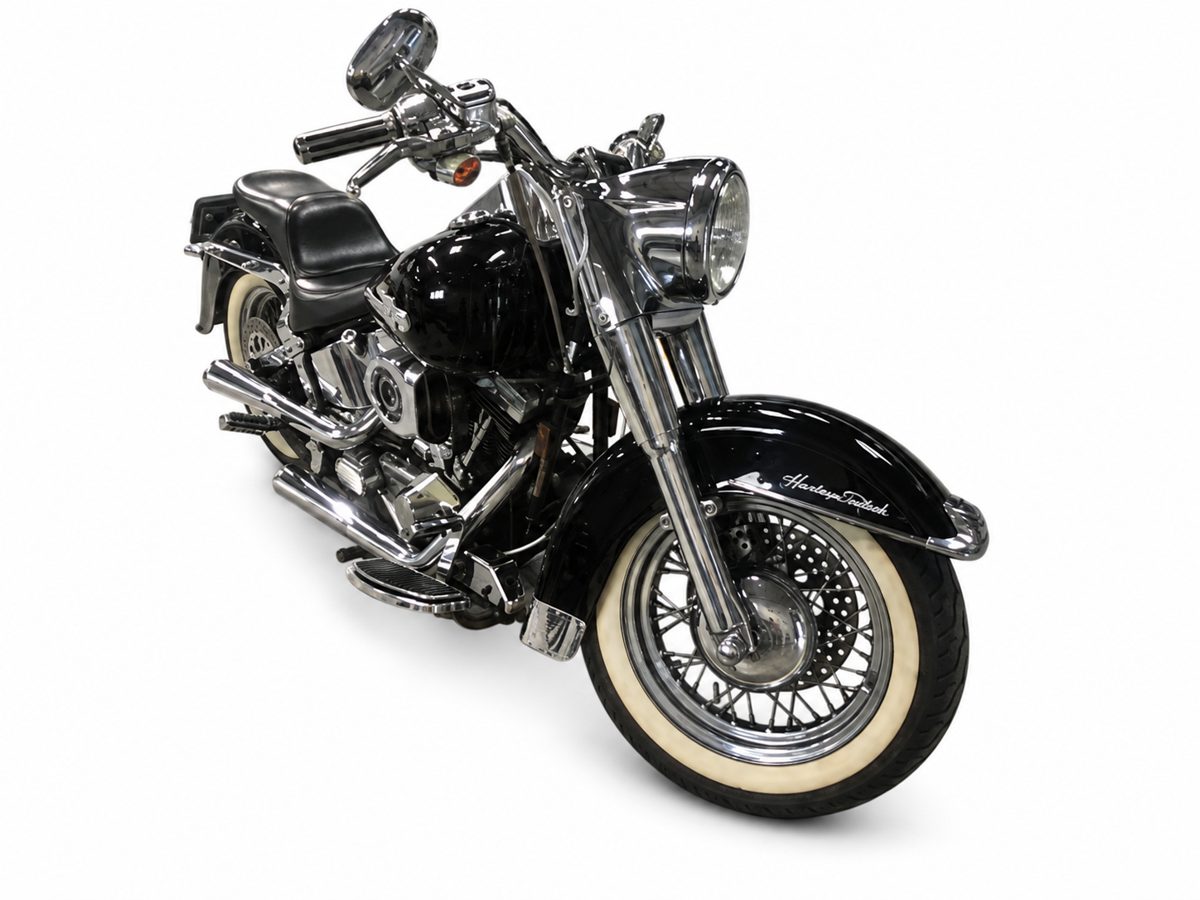
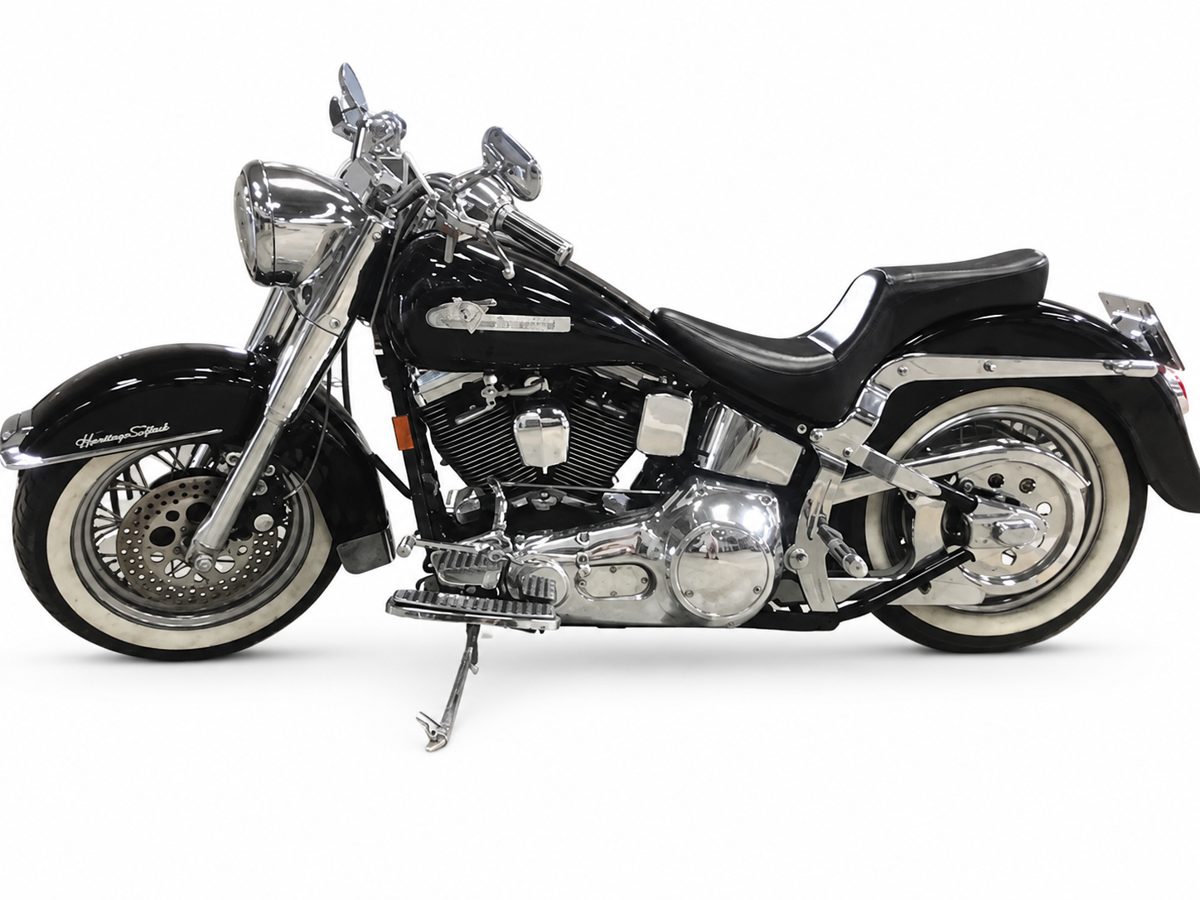
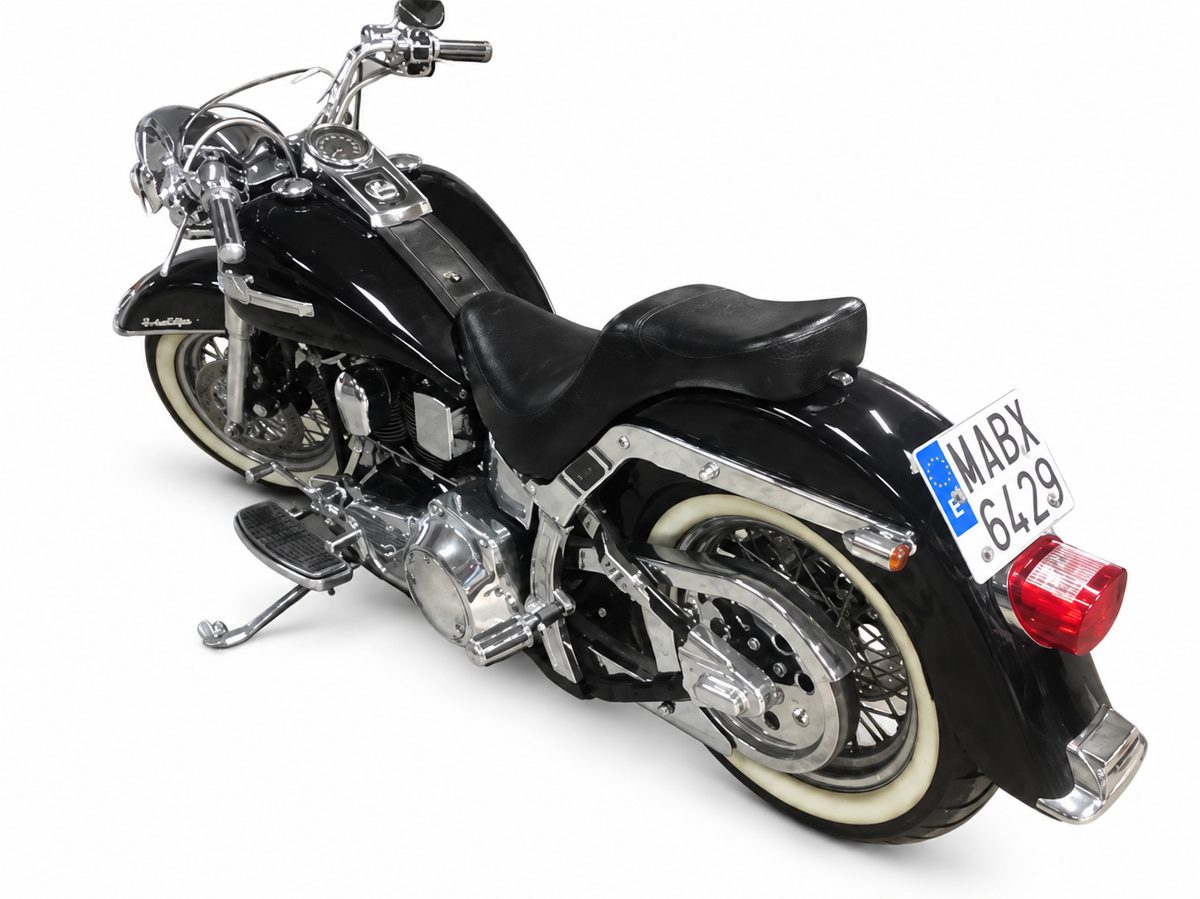
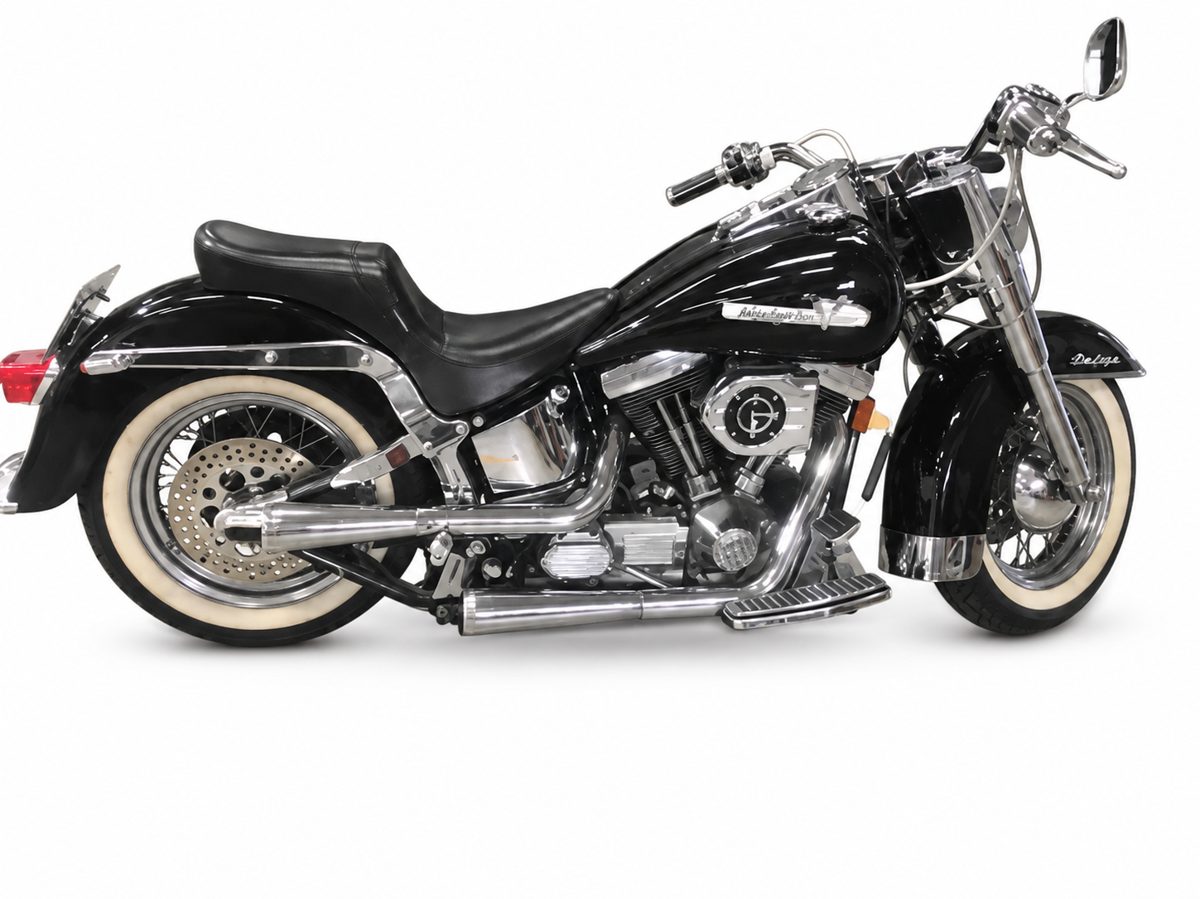
The Tropical Riders Heritage started life as a 1996 FLSTN and has passed through Ferry Clot's hands. The result keeps the essentials, the Evolution engine, the Softail chassis and the Heritage silhouette, but carries the signature of a builder who has won in Sturgis.
While we complete the full details, what we can tell you is that this is not a catalogue bike: it is a one-off with almost three decades of history, handed over serviced and ready to ride.
Riding an Evo on the Costa Tropical
We start from Puerto Marina del Este in La Herradura, a perfect base for a custom like this. Here are three route ideas (you will find more in our motorcycle routes section):
The coast on the N-340
The old N-340 national road follows the coastline between Nerja, La Herradura, Almuñécar, Salobreña and Motril. Since the A-7 motorway took most of the traffic, many stretches have become a ride of sweeping bends, cliffs and viewpoints over the Mediterranean, such as those around the Maro-Cerro Gordo Cliffs Natural Area. It is ideal Heritage territory: tall gears, low revs and the Evo's sound bouncing off the rock walls.
The Carretera de la Cabra (A-4050)
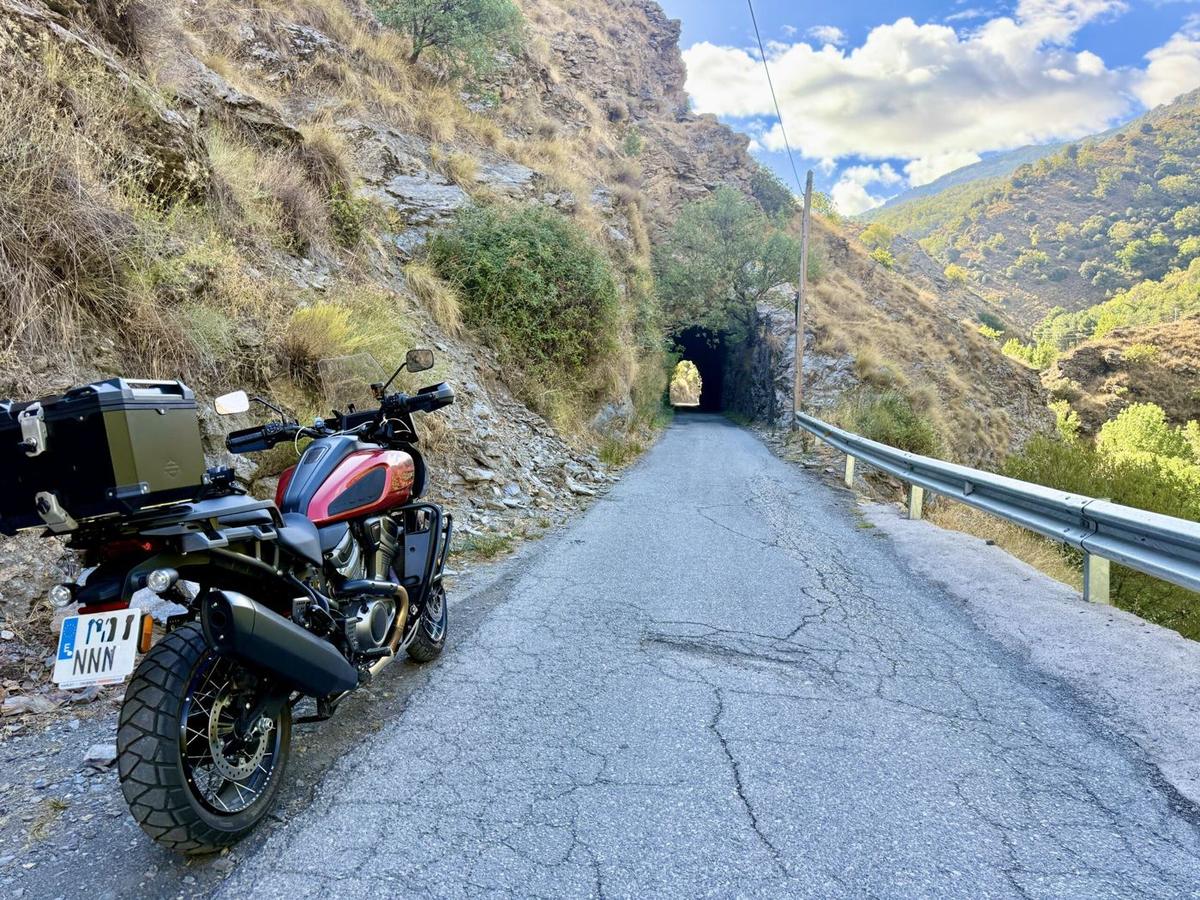
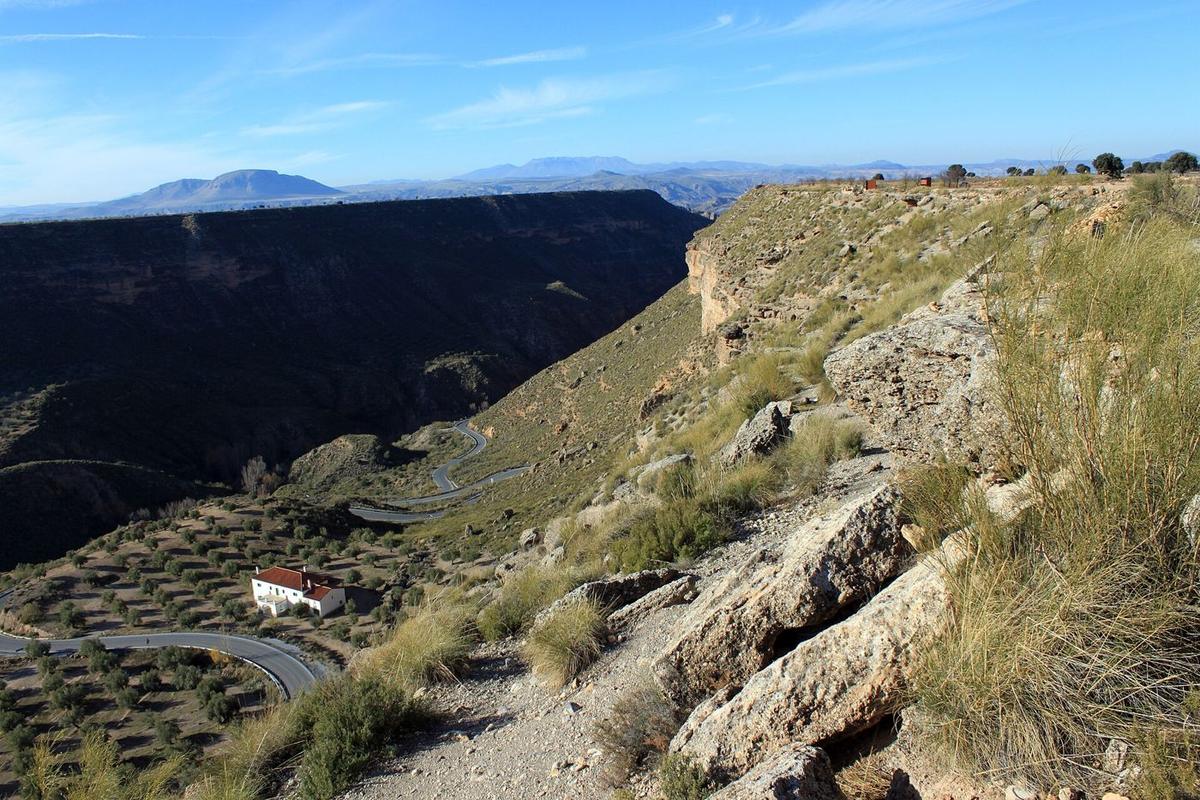
The A-4050, popularly known as the Carretera de la Cabra ("Goat Road"), links Almuñécar with the Suspiro del Moro pass over about 59 km, running through Jete, Lentegí, Otívar and Albuñuelas. It is the old mountain road between Granada and the coast: linked bends, little traffic and views towards Sierra Nevada. On a bike weighing close to 300 kg it calls for a relaxed pace and care on the narrow sections, but the reward is well worth it.
The Alpujarra
From Motril, heading up towards Lanjarón and Órgiva, you enter the Alpujarra on the southern slopes of Sierra Nevada. The white villages of the Poqueira gorge, Pampaneira, Bubión and Capileira, and beyond them Trevélez, make one of the most beautiful rides in Andalusia. These are narrow, twisty mountain roads: perfect for an unhurried day, and within the 250 km included per day if you plan the return well.
Heritage Softail Special rental conditions
As a historic, customised motorcycle, it has its own specific conditions. Here is a summary; our general terms are in the rental conditions.
| Item | Condition |
|---|---|
| Price | €200 per day (minimum 1 day) |
| Deposit | Always €2,000. Without full-coverage insurance, the customer’s credit card is also held as a guarantee in case damage exceeds the deposit |
| Full-coverage insurance | Available on request: quoted at the time with external insurers. Without it, the rider is liable for any damage |
| Mileage | 250 km/day included; €0.50 per extra km |
| Licence | Category A, held for at least 5 years |
| Experience | Proven experience on this type of motorcycle (large-capacity custom/cruiser) |
| Age | Over 30 |
| Gear | Jacket, helmet and gloves included |
| Booking | By email or contact form |
| Pick-up | At Puerto Marina del Este (La Herradura) or in Granada. This bike is not delivered |
Frequently asked questions
What do I need to rent the Harley-Davidson Heritage Softail?
A category A licence held for at least 5 years, proven experience on large custom or cruiser motorcycles, and to be at least 30 years old.
Is full-coverage insurance available?
Yes, on request. It is not included in the price: if you are interested, we need your details to request a quote from external insurers, and we then give you the price and the policy conditions. The deposit is always €2,000. Without the insurance, you are liable for any damage and, in addition to the deposit, your credit card is held as a guarantee in case the damage exceeds that amount. With full-coverage insurance, the deposit is still €2,000, but the card is not held as an additional guarantee.
How many kilometres can I ride?
The €200 daily rate includes 250 km per day. Each extra kilometre is charged at €0.50.
Exactly which year and model is it?
It is a 1996 Harley-Davidson Heritage Softail Special (FLSTN) with the 1340 cc Evolution engine, customised by Ferry Clot.
Can I book online?
Not yet. Bookings are made by email or through our contact form; please include your dates and your experience with this kind of motorcycle.
Is riding gear included?
Yes: jacket, helmet and gloves are included in the price.
Book your Evo Harley in La Herradura
If you have spent years dreaming of riding an Evolution-era Harley, this is your chance to do it on a 1996 Heritage Softail Special signed by Ferry Clot, with the Costa Tropical as your backdrop. See the Heritage Softail rental page, browse the rest of our rental motorcycles and get in touch with the dates you have in mind. We bring the bike; southern Granada brings the roads.